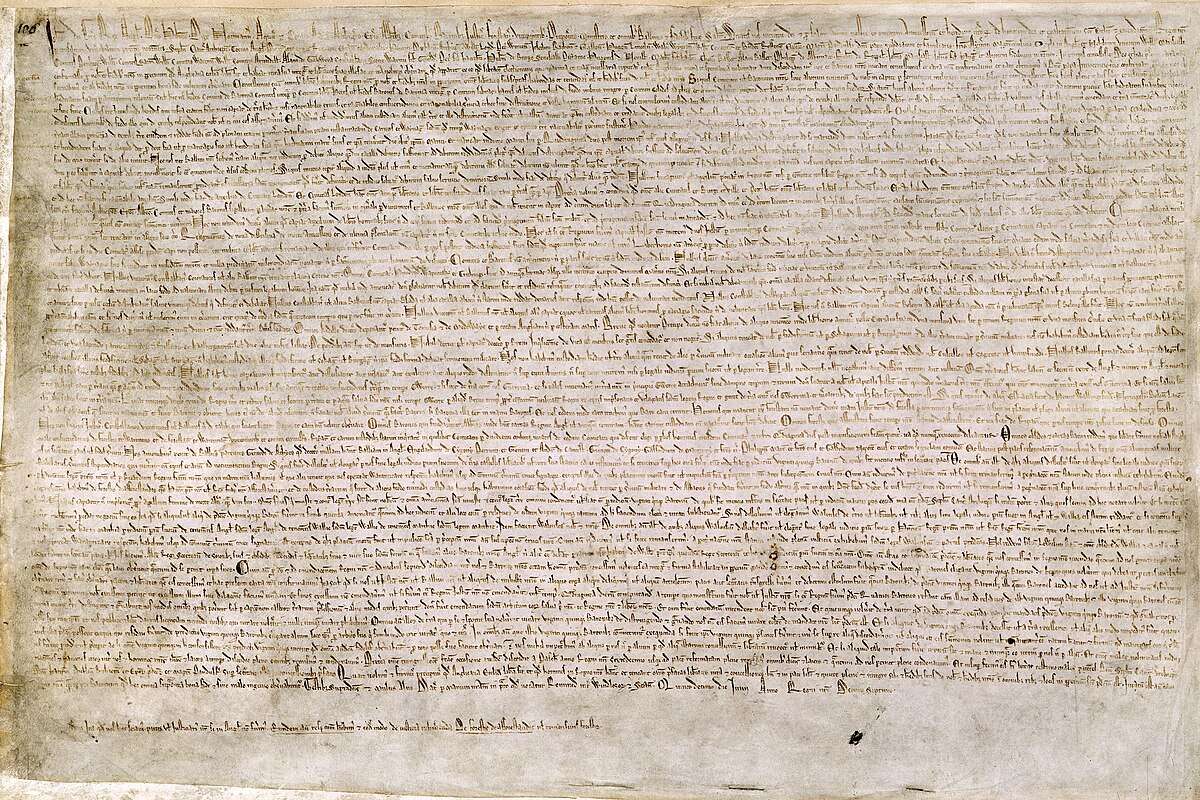
Hidden in plain sight inside Salisbury Cathedral is one of the most important documents in the history of democracy. The Cathedral holds one of just four surviving original copies of Magna Carta, sealed by King John in June 1215 — a document that helped lay the foundations for constitutional government across the English-speaking world.
What Is Magna Carta?
Magna Carta — Latin for "Great Charter" — was a peace agreement forced on King John by rebellious barons in 1215. John had been a catastrophically bad king: he'd lost most of England's French territories, taxed his barons into fury and ignored longstanding customs about royal power. By May 1215 the barons had had enough. They marched on London, occupied the city, and confronted the King at Runnymede, a meadow on the Thames near Windsor.
The result was a document containing 63 clauses covering everything from fish weirs on the Thames to the rights of widows to inherit property. But buried within those 63 clauses were two ideas that changed everything: that the King was subject to the law, not above it, and that no free man should be imprisoned without lawful judgement.
How Did Salisbury Get Its Copy?
Once agreed, copies of the Charter were written out by royal scribes onto vellum (calfskin) and sent to major churches and government centres across England. Elias of Dereham, a senior cathedral official who had actually been present at Runnymede, brought a copy to Salisbury. That connection to an eyewitness makes the Salisbury copy particularly special.
The document sat in the Cathedral's archive for centuries, occasionally consulted but not widely celebrated. It wasn't until the 17th century, when constitutional battles between Parliament and the Crown reached a crisis point, that Magna Carta was rediscovered as a foundational text. By then, many copies had been lost — only four survived.
The Four Surviving Copies
Of the roughly 13–24 copies that were made in 1215, just four survive. Two are in the British Library, one is in Lincoln Cathedral, and the fourth is in Salisbury. The Salisbury copy is particularly well-preserved — the vellum is still supple and the text still legible, even if you need Latin and a magnifying glass to read it.
In 2015, all four copies were brought together for the first time in 800 years at the British Library for the Magna Carta 800th anniversary exhibition. It was the first time they had been in the same room since 1215.
Why It Still Matters
The principles encoded in Magna Carta didn't instantly transform England into a democracy. The barons who forced it on John were mainly concerned with their own class privileges, not universal rights. John himself repudiated it immediately after signing. But the ideas it contained — that rulers have limits, that law is above personal power, that justice shouldn't be sold — proved extraordinarily durable.
Magna Carta influenced the English Bill of Rights (1689), the American Declaration of Independence (1776) and Constitution, and the Universal Declaration of Human Rights (1948). When you visit Salisbury Cathedral and stand in front of this worn sheet of vellum, you're looking at a direct ancestor of modern democracy.
Visiting the Magna Carta Today
The Salisbury Magna Carta is displayed in the Cathedral's Chapter House, alongside an original copy of the 1217 Forest Charter. The Chapter House itself is worth the visit — it's an octagonal masterpiece of Early English Gothic, with some of the finest medieval carved capitals in England depicting scenes from Genesis.
For the best experience, book a guided tour so a Cathedral guide can point out specific clauses and explain the context. Photography is permitted.


